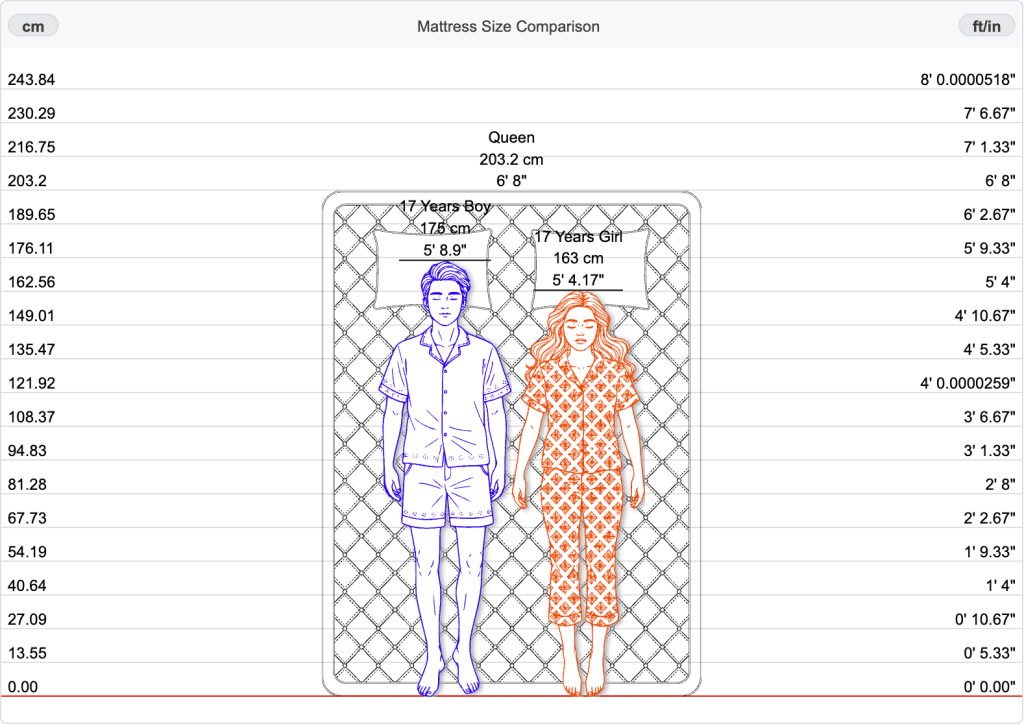
Choosing a new mattress is a significant decision, yet many of us make a crucial mistake before we even consider firmness or material: we misunderstand the size. Relying on a mattress size chart is essential, but numbers on a page can only tell you so much. Is 16 inches of extra width really a game-changer for a couple? Will a California King truly solve your height problem?
This ultimate guide goes beyond a standard mattress dimensions chart. We’ll provide the definitive reference and show you how to use cutting-edge visualization to see exactly how each bed size fits your body and your bedroom, moving you from confusion to complete confidence.
Your Definitive Mattress Size Chart
A detailed mattress size chart is the foundation of any smart purchase. The table below outlines the standard U.S. mattress dimensions, their ideal uses, and the recommended room size to ensure a comfortable fit. This bed size chart is your first stop for comparison.
| Mattress Size | Dimensions (Inches) | Dimensions (Cm) | Best For / Key Notes | Min. Room Size |
|---|---|---|---|---|
| Twin | 38″ x 75″ | 96.5 x 190.5 | Children, single adults in small rooms. | ~7 x 10 feet |
| Twin XL | 38″ x 80″ | 96.5 x 203.2 | Tall single sleepers; common in dorms. | ~7 x 10 feet |
| Full / Double | 54″ x 75″ | 137 x 190.5 | Single adults wanting more space; can be tight for two. | ~9 x 10 feet |
| Queen | 60″ x 80″ | 152.4 x 203.2 | Most popular for couples; balances space and room fit. | ~10 x 10 feet |
| King | 76″ x 80″ | 193 x 203.2 | Couples wanting maximum personal space (38″ each). | ~12 x 12 feet |
| California King | 72″ x 84″ | 182.9 x 213.4 | Best for tall individuals (over 6’2″); longer but narrower. | ~12 x 12 feet |
How to Use This Mattress Size Chart Effectively
This mattress and bed size chart is more than a list; it’s a planning tool. When reviewing it, immediately note the “Minimum Room Size” column. The dimensions listed are for the mattress itself—you must add at least 24-30 inches (2-2.5 feet) on all sides for walking space, nightstands, and doors to open. A mattress size comparison isn’t complete without room context.
Why You Can’t Rely on a Chart Alone: The Visualization Gap
While a static mattress size chart provides critical data, it has limitations. It can’t show you how a 6-foot-tall person fits on a 75-inch-long mattress. It can’t demonstrate the dramatic footprint difference between a Queen and a King in your specific 11×12 foot bedroom.
This is the visualization gap: the space between knowing the mattress dimensions and truly understanding them. Bridging this gap is the key to avoiding costly mistakes and finding a bed that feels as good in your room as it does in the showroom.
From Chart to Reality: Your Step-by-Step Selection Guide
Use this mattress size chart as the starting point for a logical decision-making process. Follow these steps to translate the numbers into your perfect fit.
Step 1: Match Size to Sleepers
Cross-reference the “Best For” column in the mattress size chart with your situation.
- Solo Sleepers: Twin, Twin XL, or Full. Choose a Twin XL for extra length.
- Couples: Start with Queen. Seriously consider a King if either partner is restless, a co-sleeper, or values ample personal space. A Full (54″ wide) gives each person only 27″–less than a Twin.
- Tall Individuals (6’2″+): Your mattress dimensions must prioritize length. Eliminate Twin and Full (75″ long). Focus on Twin XL, Queen, King, or California King (80″-84″ long).
Step 2: Measure Your Room with Precision
Grab a tape measure. Note the length and width of your room, as well as the placement of doors, windows, and vents.
- Apply the Rule: For any bed size from the chart, add 5 feet to both its length and width to calculate a comfortable minimum room size. For a Queen (60″x80″), that means a room of at least 10′ x 10′.
- Layout Test: Use painter’s tape on the floor to mark the exact mattress dimensions from the chart, including the added walking space. Can you move freely?
Step 3: Plan for the Long Term
Think ahead. Is this a “forever home” bed? Are children or pets likely to join you? Investing in a larger size now can be more cost-effective than upgrading in a few years. Consider future needs alongside today’s mattress dimensions.
📐 Step-by-Step Guide to Using the Tool
You can start using the tool by visiting the Mattress Size Comparison page on Jushify’s website.
- Select Your First Mattress Size
- Add Mattresses for Side-by-Side Comparison
- To compare sizes visually, simply repeat the first step. Click “Add Mattress” again and select a second, third, or even fourth size.
- The tool will automatically display all selected mattresses side-by-side on a single chart, scaled accurately against each other so you can see the true difference in footprint.
- Add Human Silhouettes for Real-World Context
- To see how a person fits on a mattress, use the “Add Person” feature. This opens a library of human silhouettes.
- You can use the quick options or click “Advanced” for more control. In Advanced mode, you can:
- Click “Add Person” to place them on the chart. You can add multiple figures to represent a couple or family. The figures are automatically scaled according to the chart.
- Arrange and Customize Your View
- Download or Share Your Final Comparison
Solving Common Mattress Size Chart Confusions
Even with a detailed bed size chart, certain questions always arise. Let’s clarify the most common points of confusion.
King vs. California King: The Trade-Off
Our mattress size chart shows the clear height difference: it’s a choice between width and length.
- Standard King (76″ x 80″): Maximizes width for couples. Each person gets 38 inches of personal space.
- California King (72″ x 84″): Maximizes length for tall sleepers. It’s 4 inches narrower but 4 inches longer.
The Verdict: Choose based on your priority—partner space or legroom.
The “Two vs. One” Dilemma: Split Kings Explained
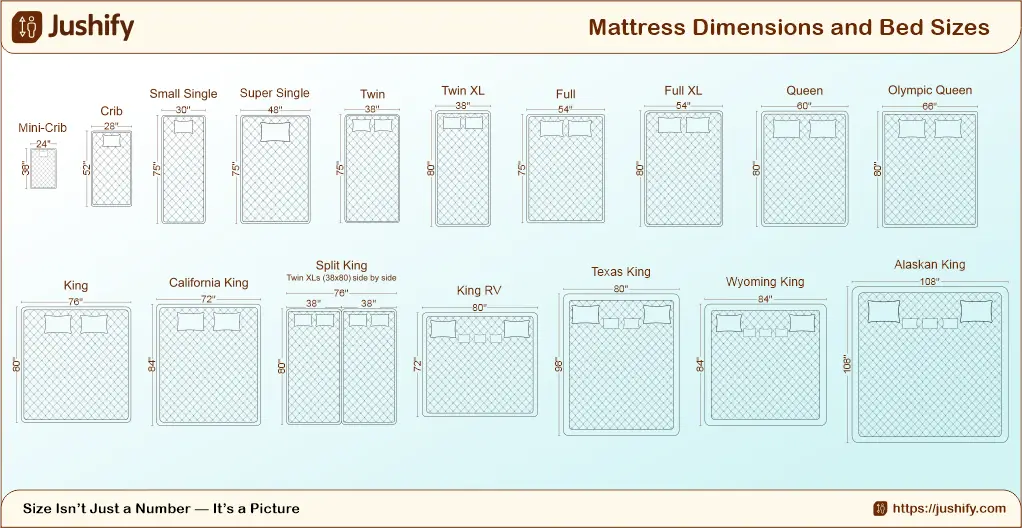
A Split King is two Twin XL mattresses (each 38″x80″) side-by-side. As our chart shows, together they equal a Standard King’s footprint (76″x80″). This setup is ideal for couples using an adjustable base, allowing each side to move independently without disturbing the other.
Navigating International Sizes
A major pitfall is assuming size names are global. A UK “King” (60″x78″) is closer to a U.S. Queen. Always, always shop by the exact mattress dimensions in centimeters or inches, not by the name alone. A good mattress size comparison tool allows you to input these custom metrics to avoid costly errors.
Bridging the Gap: The Power of Visual Comparison
This is where modern tools transform the shopping experience. Jushify’s Mattress Size Comparison Tool is designed to bring the data from this mattress size chart to life. It solves the visualization gap by allowing you to:
- Compare any two sizes from the chart side-by-side on a real-scale grid.
- Contextualize by adding customizable human figures with your exact height to see true fit.
- Customize by inputting non-standard or international mattress dimensions.
- Communicate by downloading clear visuals to share with a partner or designer.
It turns the abstract numbers from a mattress dimensions chart into tangible, understandable visuals.
Conclusion: Chart Your Course to Perfect Sleep
Start with a trusted mattress size chart—like the one provided here—to gather your essential data. Use the step-by-step framework to narrow your choices logically. Finally, close the visualization gap by using a dynamic mattress size comparison tool to see your finalists in context. By combining precise data with visual clarity, you can move beyond guesswork and invest in a mattress that fits your life perfectly, for years of restful sleep.
Frequently Asked Questions (FAQs)
What is the most accurate mattress size chart?
The most accurate mattress size chart will clearly state that it reflects U.S. standard dimensions and note that variations of +/- 1 inch can occur between manufacturers. Always cross-reference the chart with the specific product’s details before purchasing.
How much bigger is a King than a Queen?
Referring to the mattress dimensions in our chart, a King (76″x80″) is 16 inches wider than a Queen (60″x80″), while being the same length. This provides each sleeper with 8 extra inches of personal width.
Can a tall person use a Full-size bed?
It’s not recommended. A Full bed is only 75 inches long. A person who is 6 feet (72 inches) tall would have only 3 inches of space above their head and below their feet, often leading to discomfort. They should consult a mattress size chart for longer options like Twin XL, Queen, or King.
What size mattress do most couples choose?
The Queen size is the most popular choice for couples, as shown in sales data and mattress size charts. It offers a good balance of space (30 inches per person) and room compatibility. However, there’s a strong trend toward couples upgrading to a King for more spacious sleep.
Is a California King good for couples?
It can be, with a caveat. While it offers great length, our chart shows it is 4 inches narrower than a standard King. This means each person gets 36 inches of width instead of 38. It’s an excellent choice for tall couples, but standard King may be preferable if width is the higher priority.