Effects of Social Media on Mental Health: What We Know and What We Don’t
What the evidence on social media and mental health actually supports, what remains contested, and how to teach the topic without overstating either side.
On this page
The honest summary of this field is uncomfortable for everybody: the effects are real, they are smaller and more conditional than the headlines suggest, and they depend heavily on what someone is doing rather than how long they do it for.
That is a worse story than “social media is destroying a generation” and a worse story than “it’s all moral panic”, which is why neither side quotes it. If you are teaching this topic, or writing a policy about it, the nuance is the useful part.
What the evidence reasonably supports
How you use it matters more than how long
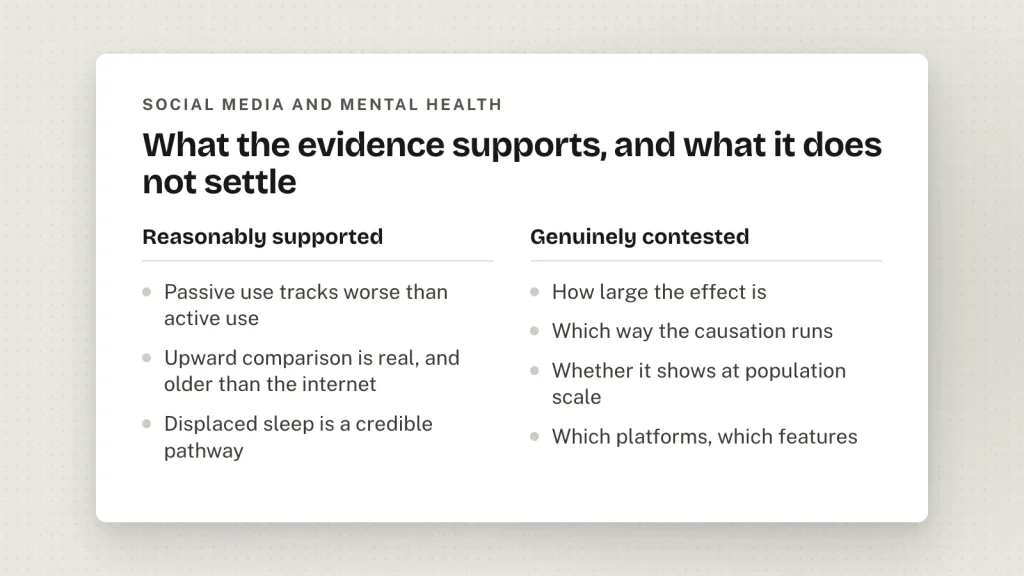
The most consistent finding across the research is that passive use — scrolling, reading, comparing — tracks worse outcomes than active use, meaning conversation with people you actually know. Two people with identical screen time can have very different experiences depending on which of those they were doing.
This is the single most practical thing to take from the literature, and it is the finding most often lost when the conversation collapses into hours per day.
Comparison is a real mechanism
Upward social comparison — measuring yourself against people who appear to be doing better — is a well-established effect that predates the internet by decades. Platforms did not invent it. They did make the comparison set much larger, much more curated, and available at 2am.
Sleep is a plausible route
Displaced sleep is one of the more credible pathways from heavy use to poorer wellbeing, and it is also the easiest thing to act on. Phones out of bedrooms is advice that does not require resolving the wider argument.
The harms are not evenly spread
Averages hide the people who matter most. For young people already struggling, for those targeted by harassment, and for those served content about self-harm or disordered eating, the effects are substantially worse than any population average implies. Policy built on an average misses them.
What is genuinely contested
Being clear about this is what separates teaching from campaigning.
- Effect sizes. Serious researchers disagree about how large the average association is, and some well-publicised analyses have found it comparable to effects nobody worries about.
- Direction. Does heavy use make people feel worse, or do people who feel worse use more? Both are supported and both are probably true at once.
- Causation at population scale. Whether platform growth caused a rise in adolescent mental-health problems is argued in good faith on both sides, and the data is messier than either camp’s summary.
- Which platforms, which features. Most research measures “social media” as one thing, which it is not.
Teaching this without overstating it
Here is where a classroom runs into a practical problem. The examples that would make the point — a comparison spiral, a pile-on, a harmful recommendation — are exactly the examples you cannot ethically put on a screen. Showing a real post means showing a real person’s account to a room, and often giving that account a new audience.
Mockups solve that specific problem. A few exercises that work:
- The highlight reel. Build the same person’s week twice with the Instagram post generator — once as they would post it, once as it actually went. Comparison becomes concrete rather than abstract.
- The engagement trap. Make one post three times with wildly different like counts and ask the class how the author feels in each. Then point out you typed all three numbers.
- The 2am message. A WhatsApp thread with timestamps running past midnight makes the sleep argument without a single statistic.
- The pile-on, safely. A comment thread that turns, built deliberately, so nobody’s real comments are read aloud.
Everything made this way is identifiable: chat mockups carry a visible “Not an original screenshot” line, and every image carries a hidden mark the verification tool reads from the original file.
What actually helps, as far as anyone can tell
Modest, boring, and better supported than most of what circulates:
- Shift passive use to active use. Messaging people you know beats scrolling past people you do not.
- Get phones out of bedrooms. The sleep pathway is the most actionable one.
- Curate aggressively. Unfollowing accounts that reliably make you feel worse works, costs nothing, and is rarely suggested.
- Teach the mechanism, not the fear. Young people who understand why a feed shows them what it does are better equipped than those told it is bad for them.
- Watch the individual, not the average. The question worth asking is not how many hours, but whether this particular person seems worse after using it.
A note on what this page is
Zeoob makes social media mockups for teaching and training. We are not a health authority, this is not advice, and nothing here should substitute for a professional if someone is struggling. What we can speak to with any authority is how this topic gets taught, and the fact that the examples teachers most need are the ones they are least able to show safely.
If you are looking for the research itself rather than a summary of it, go to the published literature and the disagreements within it — the argument between researchers is more informative than either side’s press coverage.
More on classroom use: eight lessons that work and the teachers page.