Introduction
Many parents first begin their research by asking a simple question: “How tall will my child be in the future?” Every child follows a unique growth journey. Some children grow quickly during their early years, while others experience major growth changes later. This natural variation often makes parents wonder:
“How will my child’s growth today influence their future height?”
Understanding child growth stages is one of the most important parts of learning about future height prediction.
Growth is not a continuous process that happens at the same speed throughout childhood. Instead, it occurs through different stages, each with its own biological changes and development patterns.
A child’s age, genetics, nutrition, health, and lifestyle all interact during these stages to influence growth.
While genetics provides an important foundation, understanding growth stages helps explain how inherited potential develops over time. This is why modern height prediction methods consider age and growth stage along with other important factors.
The previous article, “Genetics and Child Height: 7 Surprising Growth Facts,” explained how inherited traits influence height potential. This article explores the next important part of the journey: how children grow through different developmental stages.
Parents interested in estimating future adult height can also explore the Jushify Height Calculator, which analyzes factors such as parental height, age, gender, current height, and weight using a scientific prediction model.
Why Child Growth Stages Matter for Height
Many parents assume height development is simply about getting taller every year.
However, growth is much more complex.
During childhood, the body goes through different periods involving:
- Bone development
- Hormonal changes
- Muscle growth
- Physical maturation
- Changes in growth speed
Each stage contributes to future adult height.
For example, a child’s growth pattern during early childhood may look different from their growth pattern during adolescence. A slower-growing child at one stage may experience significant growth later.
This is why understanding growth stages provides important context when studying height prediction.
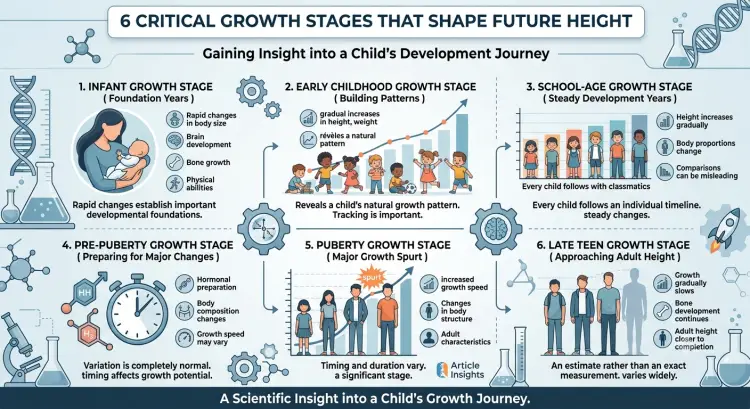
6 Critical Growth Stages That Shape Future Height
1. Infant Growth Stage: The Foundation Years
The first years of life represent one of the fastest growth periods in human development.
During infancy, children experience rapid changes in:
- Body size
- Brain development
- Bone growth
- Physical abilities
Nutrition and overall health play important roles during this stage.
Although infant growth does not determine exact adult height, it establishes important developmental foundations.
Factors that influence healthy infant growth include:
Proper Nutrition
Adequate nutrients support bone formation and overall development.
Healthy Development
Regular medical monitoring helps ensure children are developing normally.
Genetic Influence
Inherited traits begin influencing growth patterns from early life.
The infant stage creates the foundation upon which later childhood growth builds.
2. Early Childhood Growth Stage: Building Growth Patterns
After infancy, children enter early childhood, where growth becomes more consistent.
During this stage, parents often notice gradual increases in:
- Height
- Weight
- Coordination
- Physical abilities
This period helps reveal a child’s natural growth pattern.
Some children may appear taller than their peers, while others may grow at a slower pace but continue developing normally.
Early childhood growth is influenced by:
- Genetics
- Nutrition
- Sleep
- Activity levels
- Overall health
Tracking growth during this stage helps parents understand whether development is following a consistent pattern.
3. School-Age Growth Stage: Steady Development Years
The school-age years are an important period because children usually experience steady growth.
During this stage:
- Height increases gradually
- Body proportions change
- Physical strength develops
Parents often compare their children with classmates during these years.
However, comparisons can sometimes be misleading because every child follows an individual growth timeline.
A child who is shorter at one age may experience a later growth period and reach a different adult height.
This is why scientific height prediction considers multiple factors rather than relying only on current height.
The existing article “Child Height Calculator: Predict Future Height Instantly” explains how modern calculators analyze growth-related information to estimate future adult height.
4. Pre-Puberty Growth Stage: Preparing for Major Changes
Before puberty begins, children enter a transition period.
During this stage, the body prepares for significant developmental changes.
Important processes include:
- Hormonal preparation
- Body composition changes
- Continued bone development
Growth speed may vary between children during this period.
Some children begin noticeable changes earlier, while others develop later.
This variation is completely normal and highlights why age is an essential factor in height prediction.
A scientific height calculator considers age because development timing affects how much growth may still occur.
5. Puberty Growth Stage: The Major Growth Spurt
Puberty is one of the most significant stages affecting future height.
During puberty, many children experience rapid growth because of hormonal changes.
This stage can include:
- Increased growth speed
- Changes in body structure
- Development of adult characteristics
The timing and duration of puberty vary from person to person.
Some children experience growth spurts earlier, while others grow later.
This is one reason why predicting height requires more than simply looking at current measurements.
The relationship between puberty and future height demonstrates why growth science uses multiple data points.
6. Late Teen Growth Stage: Approaching Adult Height
The final stage of growth occurs during late adolescence.
During this period:
- Growth gradually slows
- Bone development continues
- Adult height becomes closer to completion
The amount of remaining growth depends on many factors, including:
- Genetics
- Development timing
- Individual growth patterns
This stage helps explain why height prediction is an estimate rather than an exact measurement.
Human growth does not follow one universal timeline.
Factors That Influence Growth During Every Stage
Although growth stages provide a general framework, several factors influence development throughout childhood.
Genetics
Genetics provides the biological foundation for height.
As explained in the previous article about Genetics and Child Height, inherited traits influence growth potential and development patterns.
Nutrition
Nutrition provides the building blocks required for healthy development.
Important nutrients support:
- Bone health
- Muscle development
- Overall growth
Sleep
Sleep plays an important role in childhood development.
Healthy sleep habits support many biological processes connected with growth.
Physical Activity
Regular movement helps support:
- Strong bones
- Healthy muscles
- Overall physical development
Health Conditions
A child’s general health can influence growth patterns.
This is why regular monitoring and professional guidance are important when concerns exist.
How Growth Stages Connect With Height Prediction
Height prediction works best when it considers where a child currently is in their development journey.
A child’s age provides important context because growth potential changes over time.
For example:
- A younger child usually has more growth years ahead
- A teenager may already be closer to adult height
- Growth timing differs between individuals
Modern height prediction models combine growth stage information with other inputs.
These may include:
- Parent heights
- Current height
- Weight
- Gender
- Age
This multi-factor approach provides a more complete estimate.
How Jushify Height Calculator Uses Growth Information
The Jushify Height Calculator is designed to analyze different factors connected with future adult height.
The calculator considers:
- Parental height as a genetic baseline
- Child’s age and growth stage
- Gender-based growth patterns
- Current height
- Weight
These inputs are processed through a multi-factor prediction model.
The system uses statistical techniques, including Linear Regression, to identify relationships between different variables.
Instead of depending on a single formula, it evaluates multiple factors together to provide an estimated adult height.
The tool also includes visual growth analysis, helping users better understand the result.
Why Growth Stage Understanding Improves Results
A height estimate becomes more meaningful when parents understand the development stage behind it.
Without growth stage knowledge, a number may seem confusing.
Understanding stages helps explain:
- Why children grow at different speeds
- Why age matters
- Why current height alone is not enough
- Why predictions can change over time
This knowledge allows parents to view height prediction as a scientific insight rather than a simple guess.
Common Mistakes Parents Make About Growth Stages
Comparing Children Too Early
Children develop at different rates.
A difference in height at one age does not always predict future adult height.
Focusing Only on Height
Growth includes many aspects of development, not just height.
Ignoring Development Timing
The same age can represent different growth stages for different children.
Expecting Linear Growth Every Year
Children do not always grow at exactly the same speed.
How Growth Tracking Helps Parents Understand Development
Growth tracking allows parents to observe changes over time.
Important measurements include:
- Height changes
- Weight changes
- Development progress
Long-term patterns provide more information than a single measurement.
The upcoming article “Height Prediction Results: 7 Things Parents Must Understand” will explain how parents can interpret prediction results and understand what estimated adult height means.
Frequently Asked Questions
What are child growth stages?
Child growth stages are different periods of physical development, from infancy through adolescence, where growth patterns and biological changes occur.
Which growth stage affects height the most?
Puberty is often associated with major growth changes, but every stage contributes to overall development.
Why does age matter in height prediction?
Age helps determine a child’s current development stage and how much growth may still occur.
Can growth stages predict exact adult height?
No. Growth stages provide important information, but adult height depends on many factors.
How does Jushify Height Calculator use growth stages?
Jushify considers age, gender, current height, weight, and parental height to analyze growth-related information and estimate adult height.
Final Thoughts
Child growth is a fascinating journey that changes through multiple stages. From infancy to adolescence, every phase contributes to physical development and future height potential.
Understanding these stages helps parents recognize that growth is not simply about being taller today. It is about how genetics, development, health, and lifestyle work together over time.
Modern height prediction combines this understanding with scientific analysis.
By considering growth stage, parental height, age, gender, current height, and weight, tools like the Jushify Height Calculator help parents explore future adult height through a more informed approach.
The next step in this journey is understanding how accurate height predictions really are and what parents should know before interpreting results.