The Importance of Social Media Simulators in Marketing
Where mockups earn their place in a marketing team — approvals, briefs, pitches and training — and the three ways they quietly mislead the people using them.
On this page
Marketing teams adopt mockups for a boring reason: approving a post from a description does not work. Someone writes a caption in a document, someone else pictures a different image under it, the thing gets signed off on a shared misunderstanding, and the disagreement surfaces after it is live.
A mockup turns an argument about intentions into an argument about a picture, which is a much shorter argument. That is most of the value, and it has nothing to do with creativity.
This covers where simulated posts genuinely help a marketing team, and — the part usually left out — the three ways they mislead the people using them.
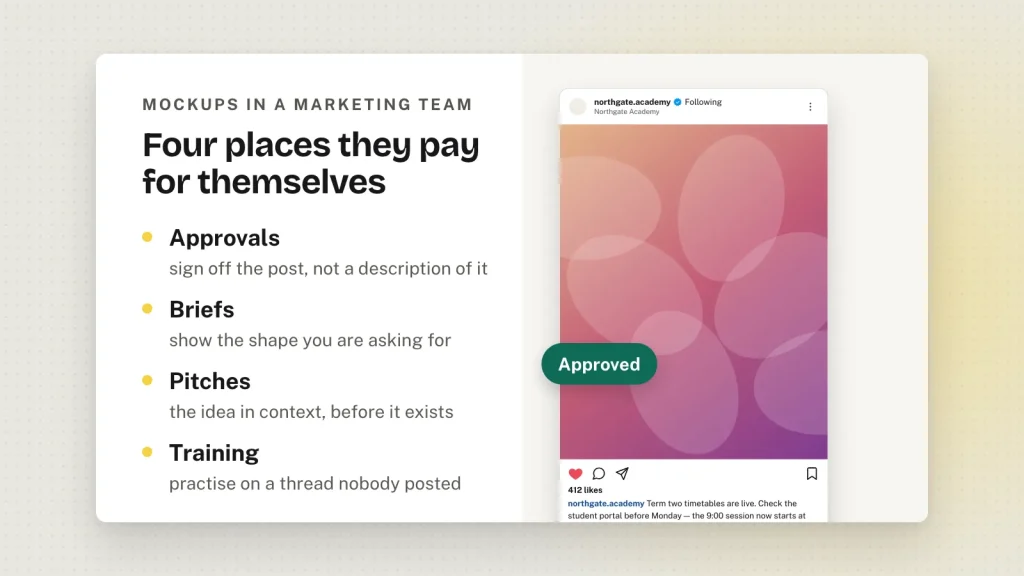
Four places they pay for themselves
Approval
A caption reads differently in a brief and under a product shot. Seeing it in place catches the line that runs past the fold, the hashtags crowding the opening, the claim that was fine in a document and looks like a promise under a photograph.
This is the use that saves the most time, because the alternative is finding out after publication.
Briefing
“Something like this, portrait, caption under 100 characters” is a brief that a photographer or a freelancer will interpret. A picture of it is an instruction they will follow. The gap between those two outcomes is usually a reshoot.
Pitching
Three proposed posts in a deck costs twenty minutes. Shooting them properly costs a day you have not been paid for. For a pitch that may not convert, the mockup is the only sane version of the work.
Training
New community managers need to practise on a hostile comment thread before they meet one. Building the thread deliberately is better than waiting for a real one and hoping. The same applies to support teams learning tone in WhatsApp or Messenger.
The three ways they mislead you
This is the section that matters, and it is missing from most articles on the subject because it argues against the tool.
1. Invented engagement becomes evidence
You can type 140,000 likes into a text field. In a deck, next to a proposal, that number stops being a placeholder and starts being an implied forecast — and nobody in the room remembers it was typed.
Use mockups to agree on what you are posting. Never let them carry a claim about how it will perform. If a number has to be on the slide, put a real one from a real campaign beside it and label both.
2. Everything in a mockup is immaculate
Real feeds have awkward crops, captions written at 4pm, and comments from people who did not read the post. A deck of perfect mockups quietly plans for a feed that does not exist, and sets an expectation the live account will not meet.
Mock up one bad case on purpose — the crop that goes wrong, the comment that misreads you. It changes the conversation.
3. They are not research
A mockup tells you what something will look like. It tells you nothing about whether anybody wants it. It is not a substitute for asking a customer anything, and it is very good at feeling like it is, because it produces an artefact.
Doing it properly
Details that decide whether reviewers react to your idea or to your mockup:
- Match the format to the platform. 4:5 on Instagram, 9:16 for stories and TikTok. Landscape in a feed reads as an advert, which is occasionally the point and usually not.
- Write the real first line. It is the only part most people read before the fold.
- Keep counts in proportion. On Instagram, roughly one comment per fifty to a hundred likes. On X, views ahead of likes ahead of reposts. Breaking the ladder is the thing a sharp reviewer spots.
- Write comments like comments. Short, lowercase, careless. Full sentences are the giveaway.
- Keep the brand consistent across tools. The same handle, avatar and tone on the post, the story and the DM — the tools share an editor, so there is no excuse for three different versions of the same account in one deck.
- Export at 3× for a deck, 4× for print.
The line a marketing team should not cross
- Never mock up another company’s account saying something it did not say. Not internally, not as a joke. Decks leak, and that is the use most likely to produce a legal letter.
- Never present invented engagement as a result. Most advertising regulators treat fabricated social proof as a misleading claim regardless of how it was produced.
- Never use a mockup of a person’s endorsement they did not give.
- Label everything. Every legitimate use works just as well with the word “mockup” on the slide.
Every image made here carries a hidden origin mark, so anyone can check an original file with the verification tool to see whether a picture came from Zeoob. A tool that makes convincing mockups ought to make them identifiable, and this one does. The responsible use page covers the rest.
Common questions
Can we use mockups in a client pitch?
Yes — one of the better uses. Say they are mockups in the deck.
Can we use them in paid advertising?
Not as a depiction of real engagement or a real endorsement.
Can we mock up a competitor?
No. Putting words in a named company’s mouth breaks our terms and is the fastest route to a problem.
Is there a cost?
No. No sign-up, no licence, HD downloads included.
Which tools cover which platforms?
Instagram posts, stories and DMs; X posts and DMs; Facebook posts and Messenger; TikTok; Snapchat; WhatsApp; iPhone messages. All of them are listed on the home page.
5 comments
-
francestrumbo
Simply want to say your article is as astounding. The clarity
in your post is just great and i could assume you are an expert on this subject. -
wallyferres
Hi, just wanted to tell you, I enjoyed this post.
It was practical. Keep on posting! -
Loiko
A big thank you for your article.Thanks Again. Want more.
-
Lan
Thanks a lot for the blog.Thanks Again. Will read on…
-
StacyPerrett
Very good post.