Introduction
Parents often search for answers about their child’s future growth:
“Can height prediction really tell how tall my child will become?”
This question is natural because height is one of the most visible parts of human development. However, understanding future height requires more than making a simple guess based on appearance or family patterns.
Height prediction accuracy depends on several important factors, including the quality of data, scientific methods, growth patterns, and how different biological influences are analyzed.
Modern prediction methods have improved significantly because they no longer rely only on simple calculations. Advanced height prediction tools consider multiple factors together, such as parental height, age, gender, current height, weight, and growth stage.
The goal of a scientific height prediction tool is not to guarantee an exact future result. Instead, it provides an estimated adult height based on available information and statistical analysis.
The previous articles “How Tall Will My Child Be? Best Height Prediction Guide,” “Genetics and Child Height: 7 Surprising Growth Facts,” and “6 Critical Growth Stages That Shape Future Height” explained how genetics and development influence growth. This article focuses on another important question: how reliable are height predictions, and what should parents understand before using them?
Parents can also explore the Jushify Height Calculator, which uses a multi-factor prediction approach to estimate future adult height by analyzing different growth-related inputs.
What Does Height Prediction Accuracy Really Mean?
When people hear the word “accuracy,” they often expect a prediction to match the final result perfectly.
However, human growth is not a fixed mathematical process.
A child’s final adult height is influenced by:
- Genetics
- Growth timing
- Health
- Nutrition
- Lifestyle
- Biological differences
Because these factors continue changing throughout childhood, no height prediction method can provide a guaranteed outcome.
Instead, height prediction accuracy refers to how effectively a scientific model uses available information to create a meaningful estimate.
A reliable prediction system:
- Uses relevant growth data
- Applies scientific calculations
- Considers multiple influencing factors
- Avoids unrealistic promises
Understanding this difference helps parents use height calculators more effectively.
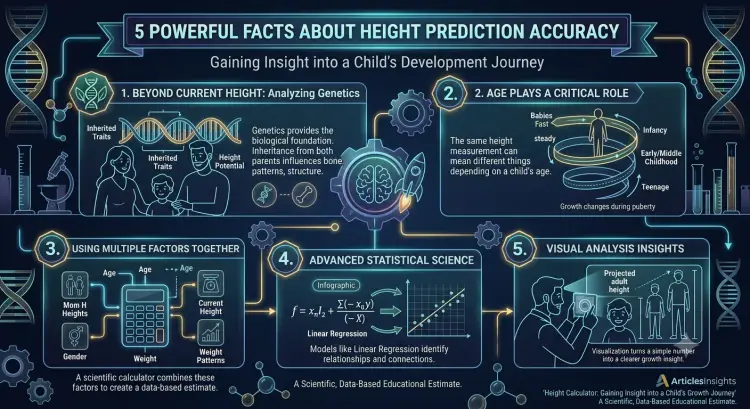
5 Powerful Facts About Height Prediction Accuracy
1. Multiple Factors Improve Height Prediction Quality
One of the most important facts about height prediction accuracy is that better predictions require more than one piece of information.
Simple methods may rely only on:
- Parents’ height
- A basic formula
While this can provide general guidance, it does not represent the complete picture of human growth.
Modern approaches analyze multiple factors together, including:
- Child’s age
- Gender
- Current height
- Weight
- Parental height
- Growth stage
When different factors are combined, the prediction model gains a better understanding of the child’s current development.
This is why advanced height calculators use multi-factor analysis instead of depending on a single measurement.
2. Genetics Influences Accuracy but Does Not Determine Everything
Genetics is one of the strongest influences on height prediction.
A child inherits many growth-related traits from both parents, including factors connected with:
- Bone development
- Body structure
- Growth patterns
As explained in the article “Genetics and Child Height: 7 Surprising Growth Facts,” parental height provides valuable information about inherited growth potential.
However, genetics is not the only factor.
Two children with similar genetic backgrounds can still follow different growth journeys because development is influenced by many other elements.
This is why a scientific height prediction model combines genetic information with additional growth data.
3. The Quality of Input Data Affects Prediction Results
A height prediction tool can only analyze the information provided.
Accurate input helps create a more meaningful estimate.
Important information includes:
Current Height
Current height shows where the child is within their growth journey.
Weight
Weight provides additional context about physical development.
Age
Age helps identify the child’s current growth stage.
Gender
Gender helps account for differences in typical growth patterns.
Parent Heights
Parental height provides genetic background information.
Entering incorrect measurements may affect the resulting estimate.
This is why parents should use accurate and updated information when using a height calculator.
4. Scientific Models Are More Reliable Than Simple Guessing Methods
Many people try to predict height using simple observations:
“My child is tall now, so they will definitely become tall.”
or:
“Both parents are short, so the child cannot become tall.”
These assumptions ignore the complexity of human growth.
Scientific prediction models use statistical methods to identify relationships between different variables.
One commonly used technique is Linear Regression.
Linear Regression helps analyze how different factors relate to an outcome.
In height prediction, it can evaluate relationships between:
- Parent height
- Child measurements
- Age
- Development patterns
This allows a prediction model to combine several pieces of information instead of depending on assumptions.
5. Visual Analysis Helps Parents Understand Prediction Results
A prediction number alone may not always be easy to interpret.
Parents may ask:
“What does this result mean?”
Visual analysis can make growth information easier to understand.
A visual growth graph can help users:
- See growth patterns
- Understand proportions
- Interpret estimated adult height more clearly
The Jushify Height Calculator includes visual growth analysis because understanding the information is just as important as receiving the result.
Visualization transforms data into a clearer growth story.
Why Height Predictions Cannot Be 100% Exact
Many parents expect technology to provide an exact future height.
However, human development is affected by many changing factors.
Reasons exact prediction is difficult include:
Individual Growth Differences
Every child develops at a unique pace.
Different Puberty Timing
Children experience growth changes at different ages.
Health and Lifestyle Changes
Future conditions can influence development.
Biological Variation
Human growth naturally includes differences between individuals.
A responsible height prediction tool explains these limitations while still providing useful information.
How Height Prediction Science Has Improved
Height prediction has evolved from simple calculations into more advanced analytical systems.
Earlier methods often focused on limited information.
Modern approaches use:
- Growth research
- Statistical models
- Multiple input analysis
- Development patterns
This improvement allows prediction tools to provide more personalized estimates.
The previous article “How Height Calculators Predict Your Child’s Growth” explains the science behind how these systems process information and create predictions.
How Jushify Height Calculator Approaches Prediction Accuracy
The Jushify Height Calculator follows a scientific approach by analyzing multiple factors connected with growth.
The tool considers:
- Parental height as a genetic baseline
- Age
- Gender
- Current height
- Weight
- Growth-related information
These inputs are processed through a multi-factor prediction model.
Instead of relying on one traditional formula, the system analyzes relationships between different variables using statistical methods, including Linear Regression.
The result is an estimated adult height based on the information provided.
The tool also provides visual growth analysis, allowing users to better understand the prediction.
Why Parents Should Understand Prediction Limitations
A height calculator is a helpful educational tool, but it should not create unnecessary pressure.
Every child has a unique development journey.
Parents should focus on:
- Supporting healthy habits
- Providing proper nutrition
- Encouraging physical activity
- Monitoring healthy development
A prediction should be viewed as information, not a fixed expectation.
The purpose of height prediction is understanding growth, not comparing children.
Common Misunderstandings About Height Prediction Accuracy
A Prediction Is a Guarantee
A height prediction is an estimate, not a promise.
Current Height Determines Final Height
Current height is only one part of the analysis.
Genetics Alone Predicts Everything
Genetics matters, but other factors influence development.
All Height Calculators Work the Same Way
Different calculators use different methods and levels of analysis.
A Higher Number Means Better Growth
Healthy growth is about overall development, not only height.
How Parents Can Get More Meaningful Height Predictions
Parents can improve the usefulness of a height prediction by:
Providing Accurate Information
Use correct measurements when entering data.
Understanding Growth Stages
Knowing where a child is developmentally provides important context.
Looking at Long-Term Patterns
Growth trends are more meaningful than single measurements.
Using Scientific Tools
Choose tools that analyze multiple factors rather than simple formulas.
Frequently Asked Questions
How accurate are height calculators?
Height calculators provide scientifically based estimates, but actual adult height may vary because growth depends on many biological factors.
What affects height prediction accuracy?
Accuracy depends on the quality of input data, scientific methods, and how many growth factors are considered.
Does parental height improve prediction?
Yes. Parental height provides important genetic information that helps establish a growth baseline.
Can a height calculator predict exact adult height?
No. It provides an estimated adult height based on available information and statistical analysis.
Why does Jushify Height Calculator use multiple factors?
Because human growth is complex. Combining age, gender, current height, weight, and parental height creates a more complete analysis.
Final Thoughts
Height prediction accuracy depends on understanding the science behind growth rather than expecting a perfect future measurement.
Reliable prediction methods combine genetics, development information, current measurements, and statistical analysis to create meaningful estimates.
Parents should remember that every child follows a unique growth path. A height prediction is not a limitation or a guarantee; it is a scientific insight based on current information.
By using a multi-factor approach, tools like the Jushify Height Calculator help parents better understand the relationship between genetics, growth stages, and future adult height.
The next important step is learning how to interpret these predictions correctly, which will be covered in “Height Prediction Results: 7 Things Parents Must Understand.”