How Do You Start Social Media Marketing? 7 Steps to Get Started
Seven steps from nothing to a running account — choosing a platform, planning the first month, and the mistakes that kill most new accounts by week four.
On this page
- 1. Decide what the account is for
- 2. Pick one platform
- 3. Work out what you can make, repeatedly
- 4. Set the account up properly
- 5. Plan the first month before publishing anything
- 6. Publish, and answer everybody
- 7. Review at six weeks, not six days
- The four things that actually kill new accounts
- Common questions
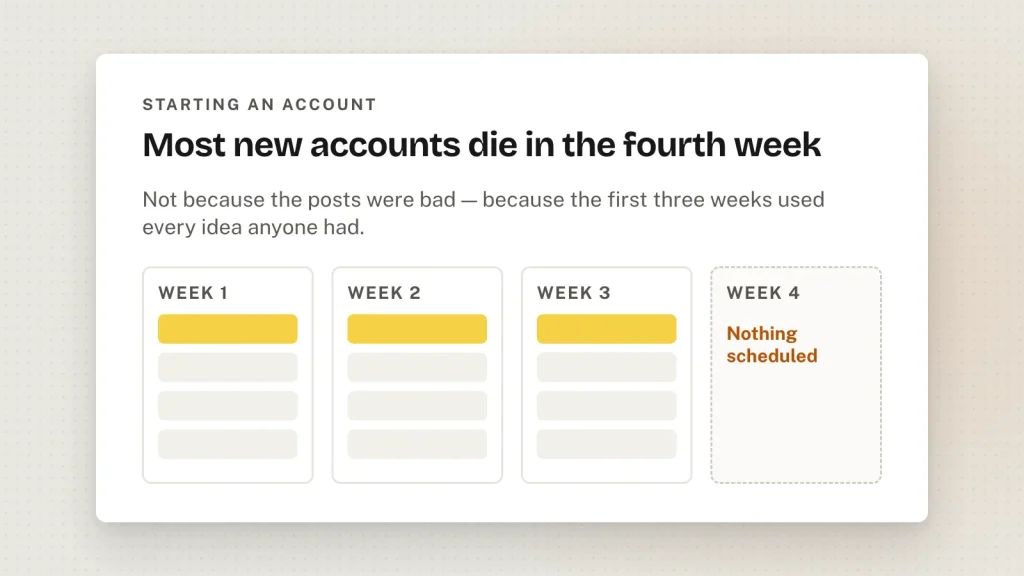
Most new business accounts die in the fourth week. Not because the posts were bad, but because the first three weeks used up every idea anyone had and nobody had built a way to produce the fourth.
These seven steps are ordered to avoid that. The early ones are unglamorous on purpose.
1. Decide what the account is for
One sentence, written down, that somebody could disagree with. “Get more customers” is not it. “Make local people aware we do repairs as well as sales” is.
This matters because it decides everything after it, and because without it nobody can tell whether the account is working. Most accounts that feel like a chore feel that way because nobody can answer this question.
2. Pick one platform
One. The temptation is to claim the handle everywhere and post to all of them, and that is how most teams end up posting properly to none.
Choose on two questions: where are the people you want, and what can you actually make every week? A business that cannot produce video should not build a plan around TikTok, however well it is performing for someone else.
Add a second platform when the first one is running itself. Not before.
3. Work out what you can make, repeatedly
The constraint is not ideas. It is production. Before planning content, answer honestly: who takes the photos, who writes the words, who presses publish, and what happens when that person is on holiday?
Pick formats that survive that answer. Three or four repeatable types — a before-and-after, a question answered, a thing arriving, a staff member explaining something — beats a plan of thirty individually brilliant ideas that nobody can execute twice.
4. Set the account up properly
Half an hour, once:
- A name people would search for, not a clever one.
- A bio that says what you do and where, in the first line.
- A link that goes somewhere useful.
- A profile picture legible at the size it actually appears — which is small.
- Contact details that work.
5. Plan the first month before publishing anything
Twelve posts, roughly three a week, written and scheduled before the first one goes out.
This is the step that prevents the week-four collapse, and it is the one people skip because publishing is more satisfying than planning. Being four weeks ahead means a bad week costs you nothing.
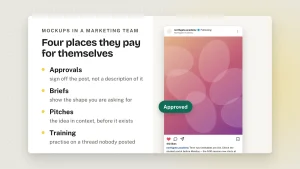
Mock the posts up as you plan them. A caption in a spreadsheet and a caption under an image are different things — the line that reads fine in a document runs past the fold under a photo, and the opening sentence you were proud of turns out to be hidden behind hashtags. Building them in the real format with the post generator or the Facebook generator catches that before publication rather than after.
It also makes approval quick, which matters if anyone else has to sign off.
6. Publish, and answer everybody
For the first few months, reply to every comment and every message. All of them.
Early accounts grow through conversation rather than reach, and a reply costs nothing and is visible to everyone reading. This is also the stage where you learn what people actually want to know, which is rarely what you assumed.
If replying in public makes you nervous, write the awkward exchange out first — a Messenger or WhatsApp mockup of a complaint and a good answer is a useful thing to agree on before the real one arrives at 9pm.
7. Review at six weeks, not six days
Early numbers are noise. At six weeks, ask three things:
- Which posts did people do something with? Saves, shares and replies, not likes — they cost the person something.
- Were they the right people? Reach from the wrong place is worse than a little from the right one.
- Which format was easiest to make? The sustainable one usually beats the clever one over a year.
Then do more of what worked and drop what did not. That is the whole loop.
The four things that actually kill new accounts
- Too many platforms. Covered above, and the most common.
- No buffer. Publishing the day you make it means one bad week ends the run.
- Posting only about yourself. Offers and announcements only works for an audience you do not have yet.
- Changing the plan every fortnight because a post underperformed. Six weeks before judging anything.
Common questions
How often should we post?
As often as you can keep up for six months. Two a week sustained beats daily for a month and then nothing.
Do we need to pay?
Not to start. Paid buys reach quickly and stops when the budget does; get the organic account working first so there is something for the paid reach to land on.
How long before it works?
Months, for organic. Anyone promising faster is selling ads or selling you something.
Should we use a scheduling tool?
Once you are planning a month ahead, yes. Before that it is a tool for publishing nothing on time.
Next: what social media marketing is and building a wider strategy.