What Is Social Media Marketing? And Why It Matters
What social media marketing actually involves, what it is good and bad at, and how to plan a post before you publish it.
On this page
Social media marketing is using social platforms to reach people who might buy from you, work with you, or tell someone else about you. That is the whole definition. Everything else is detail about which platforms, what you post, and how you know whether it worked.
The detail is where it goes wrong, usually in the same three places.
What it actually consists of
Four activities, which get muddled together and have different costs:
- Organic posting. Publishing to an account people chose to follow. Cheap, slow, compounds.
- Paid. Buying reach to people who did not follow you. Fast, measurable, stops the moment you stop paying.
- Community. Replying, moderating, handling complaints in public. The least glamorous and the part customers remember.
- Influencer and partnership. Paying or persuading someone else’s audience to hear about you.
Teams that describe themselves as “doing social” are often doing one of these and assuming the results of another.
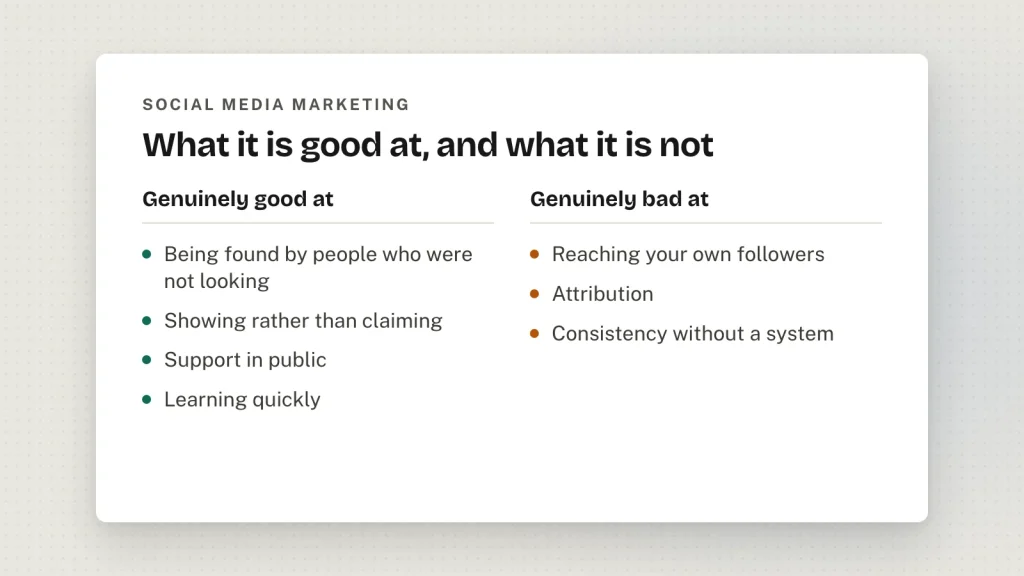
What it is genuinely good at
Being found by people who were not looking. Search reaches people with a stated need. Social reaches people before they have one, which is the only route for a product nobody is searching for yet.
Showing rather than claiming. A product that is hard to describe and easy to demonstrate belongs on a visual platform.
Support in public. Answering one complaint visibly answers it for everyone watching, which is a genuine efficiency and the reason messaging channels matter more than their follower counts suggest.
Learning quickly. You can test a message to a few thousand people this afternoon.
What it is bad at
Rarer, so worth stating plainly.
Reaching your own followers. Organic reach on most platforms is a fraction of an audience you spent years building. A follower count is not a mailing list.
Attribution. Knowing which post produced which sale is genuinely hard, and most dashboards answer a slightly different question than the one being asked.
Consistency without a system. Most accounts do not fail because the content is bad. They fail because the fourth week arrives and nobody has anything scheduled.
Choosing where to be
The honest rule is: fewer platforms, done properly. One account posting well beats five posting rarely, and five accounts is how most small teams end up doing none.
Pick on two questions — where are the people you want, and what can you actually make every week? A business that cannot produce video should not build a plan around it.
Planning a post before you publish it
This is the practical part, and the step most often skipped.
A caption in a document and a caption under an image are different objects. The line that reads well in a brief runs past the fold under a photo; the hashtags that looked fine on their own crowd out the opening sentence. You find this out after publishing, or you find it out before.
Mocking the post up first takes a few minutes:
- Build it in the format you will actually post — 4:5 for an Instagram post, 9:16 for a story or TikTok, the real thing for a Facebook post.
- Write the real first line, because that is the only part most people read.
- Show it to one person who was not in the discussion and ask what they think it is selling.
- Fix whatever they got wrong, then publish.
Use mockups to agree on what you are posting. Do not use the invented like counts as a forecast — they are a text field, and a deck full of them will quietly convince a room that a weak idea is strong. There is more on that trap in the piece on simulators in marketing.
Measuring it without fooling yourself
Three questions that beat a dashboard:
- Did anybody do anything? Saves, shares and replies mean more than likes, because they cost the person something.
- Did the right people see it? Ten thousand impressions from the wrong country is a worse result than four hundred from the right city.
- Would you have known if it had not run? If the answer is no, you are not measuring the thing you think you are.
Common questions
How often should we post?
As often as you can sustain for six months. That number is lower than whatever a guide told you, and it is the one that works.
Do hashtags still matter?
Less than they did, and they vary by platform. A few relevant ones, not a block of thirty.
Do we need paid?
For reach at speed, yes. For building something that keeps working after the budget stops, no.
How do I brief a designer?
With a picture, not a paragraph. A mockup is the shortest brief there is.
Next: seven steps to get started and building a strategy.