How to Build a Digital Marketing Strategy in 6 Steps
Six steps to a strategy that fits on one page — what to decide, what to measure, and why most strategy documents fail before they are finished.
On this page
Most digital marketing strategies fail as documents before they fail as plans. They run to thirty slides, they are written once, nobody reads them again, and six weeks later the team is doing whatever seems urgent.
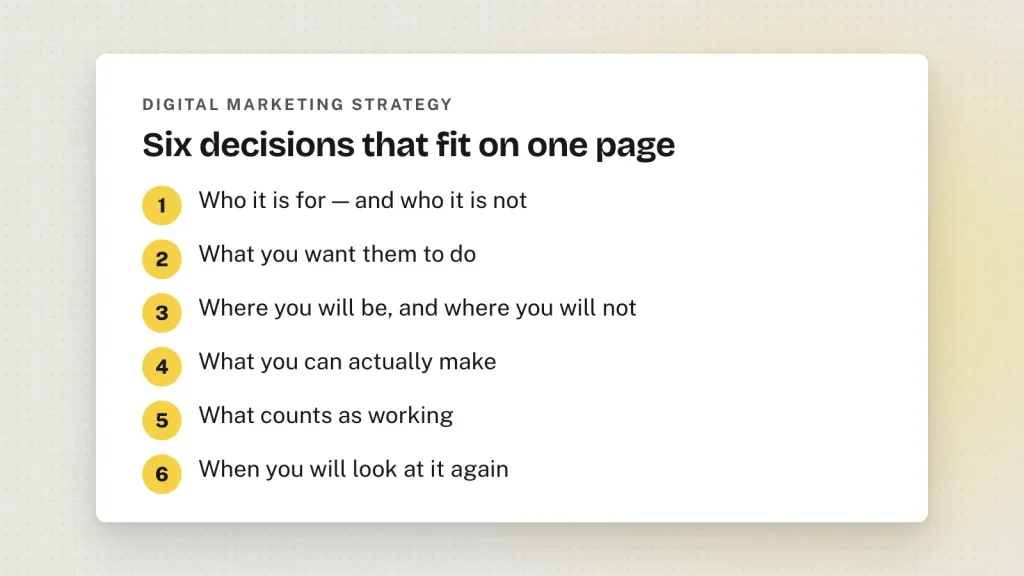
A strategy that works is short enough that people remember it. Six decisions, one page. Everything below is about making those six decisions well.
1. Decide who you are for — and who you are not
The second half is the one that gets skipped and the one that does the work.
“Small businesses” is not an audience. “Independent repair shops with one to five staff who currently get customers by word of mouth” is, because it rules things out. A strategy that rules nothing out is a wish list, and it will be reinterpreted by every person who reads it.
Write down one group you are explicitly not chasing. If you cannot, you have not finished this step.
2. Decide what you want them to do
One primary action. Buy, enquire, subscribe, book, download.
Teams that want all five get none, because every channel gets pulled in a different direction and the website asks for everything at once. Pick the one that matters this year; the others can be secondary.
3. Decide where you will be, and where you will not
Channels fall into three jobs, and most strategies confuse them:
| Job | Channels | Reaches |
|---|---|---|
| Being found | Search, directories, maps | People who already have the need |
| Being noticed | Social, video, partnerships | People before they have it |
| Being remembered | Email, community, retargeting | People who already met you |
Most small teams need one from each row and nothing else. Running six channels badly is the commonest failure mode in the whole discipline, and it is nearly always a resourcing problem dressed up as a strategy problem.
Name what you are not doing. Written down, so that in March nobody starts a podcast.
4. Decide what you can actually make
The constraint is never ideas. It is production capacity, and strategies routinely assume capacity nobody has.
Answer honestly: who writes, who shoots, who approves, who publishes, and what happens when that person is away for two weeks? Then pick formats that survive the answer.
Three or four repeatable formats beat a plan of brilliant one-offs. If something cannot be made twenty times, it is a campaign, not a format.
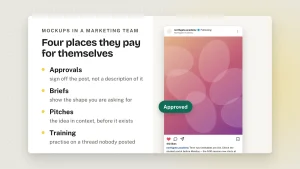
Mock up the formats before committing to them. Building a month’s worth as post mockups takes an afternoon and tells you two things a document cannot: whether they look like a coherent account when seen together, and whether you can actually fill them. A format that is hard to populate with placeholder content will be impossible to fill with real content in week nine.
5. Decide what counts as working
Before anything launches, write the number that would make you continue and the one that would make you stop.
This feels pedantic and it prevents the most expensive failure in marketing: a channel that nobody can defend and nobody will kill, absorbing a day a week for two years.
Pick measures that cost the audience something — enquiries, bookings, replies, saves — over measures that cost them nothing. Impressions and follower counts move for reasons unrelated to anything you did.
6. Decide when you will look at it again
Put a date on it. Quarterly is usually right: long enough that results mean something, short enough to stop a bad channel running all year.
At each review, three questions:
- Which channel produced the primary action from step 2?
- Which one are we keeping out of habit?
- What did we learn that changes step 1?
A strategy that never changes is not being used.
The one-page test
When it is finished, it should fit on one page:
- Who it is for, and who it is not.
- The one action we want.
- Three channels, and the ones we are not doing.
- Three or four formats we can make every week.
- The number that means it is working.
- The date we look again.
If it does not fit, it is a document rather than a strategy, and documents do not survive contact with a busy quarter.
Common questions
How long should a strategy run before we judge it?
A quarter for signals, a year for search and organic social. Judging organic channels monthly produces the thrash that kills them.
What if we have no budget?
Then step 4 matters more than everything else, because your constraint is time. Pick fewer formats and keep them running.
Should the strategy name specific posts?
No. It names formats and decisions. Posts belong in a calendar, which changes weekly; a strategy that lists posts has to be rewritten every time one changes.
Who should write it?
Whoever will be held to it. A strategy written by someone who does not have to execute it is a wish list.
Related: what social media marketing is, seven steps to get started, and where mockups help and where they mislead.
5 comments
-
SEO Brisbane
Digital marketing involves the tools, processes, content, and techniques used to increase an organization’s or company’s profits, traffic, or any other goal that involves the digital world.
-
d7kmjayylv
A fascinating discussion is definitely worth comment. Very well explained!
-
Johnson sturgis
Howdy! Nice elaboration. Good to go
-
Kimberley
First of all I want to say awesome article! I had a quick question which I’d like to ask if you do
not mind. I was interested to know how you center yourself and clear your
mind prior to writing. I’ve had a tough time clearing my thoughts in getting my thoughts out there. -
lynwooddisney
Tremendous things here. I am very glad to see your article.
Thanks so much and I’m taking a look forward to contact you.